







Two-Day Workshop on Labour Laws, New Labour Codes & Legal Thinking for HR held
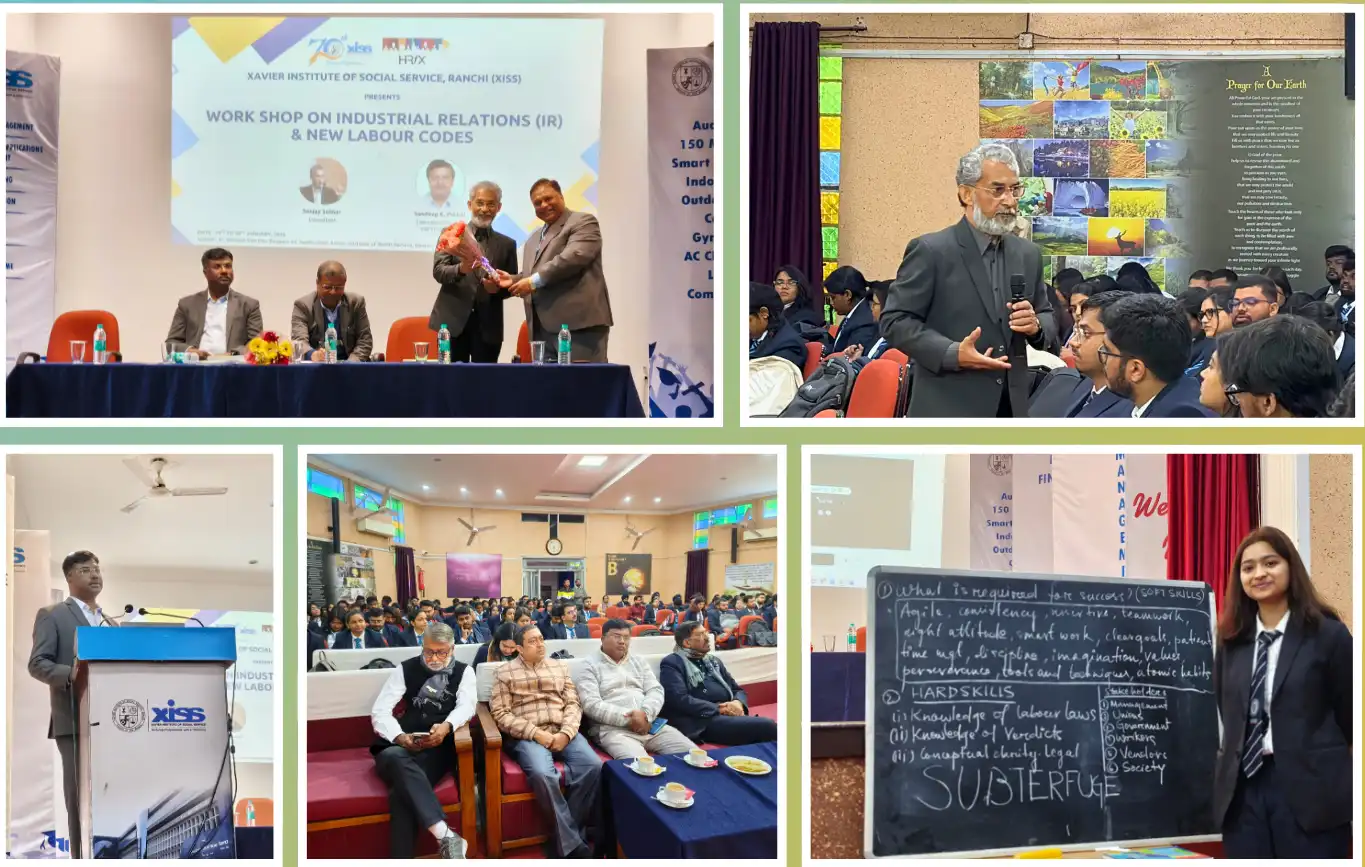
A two-day workshop on Labour Laws, New Labour Codes & Legal Thinking for HR was organized at XISS on 19 and 20 January 2026. The workshop conducted to develop strong clarity on labour laws and the newly introduced labour codes was commenced by Mr Sandeep Puthal, a seasoned HR Leader and an alumnus of PGDM PM & IR, Batch of 1984-86 & Mr Sanjay Suthar, an HR Consultant.
The workshop was designed to help students and HR professionals understand how labour reforms influence industrial relations, compliance requirements, and HR decision-making. The workshop also aimed at strengthening participants’ ability to interpret labour laws in practical workplace scenarios
The speakers emphasized that HR professionals must build legal reasoning to handle workplace disputes, employee relations issues, and statutory compliance effectively. Understanding the intention behind provisions was highlighted as essential for correct decision-making.
Major takeaways from the workshop:
Reform Approach: Reform → Perform → Transform
A key concept discussed was the framework of “Reform → Perform → Transform.” The speakers explained that organizations cannot operate with old systems after reforms. Instead, they must first enhance their performance with updated practices and then transform HR systems and compliance processes according to the new labour code framework.
Codification: Shift from Labour Laws to Labour Codes
A major learning was understanding how multiple labour laws are consolidated under four labour codes. These include: • Industrial Relations Code (IR Code) • Code on Wages • Code on Social Security • Occupational Safety, Health and Working Conditions Code (OSHWC) Codification
Key Reforms under New Labour Codes (Ease of Doing Business)
Key changes discussed included:
- Reduction in inspector/control-based systems and increased structured governance
- Simplified compliance process and better transparency
- Compounding offences in many situations rather than criminal prosecution
- Supportive legal environment for business growth without compromising employee welfare

On Day 2 of the workshop, students actively contributed through PPT presentations on key labour law topics. Presentations covered maternity provisions, apprenticeship rules, and other labour law-related themes, enabling peer learning and helping participants relate legal concepts to HR policy and compliance implementation. This activity improved engagement, confidence, and practical understanding of labour regulations.
The concluding interaction included Q&A and SWOT analysis to evaluate learning, identify improvement areas, and enhance readiness for applying knowledge in real settings.
By the end of the two-day workshop, participants gained the ability to:
- Develop legal and analytical thinking for HR and industrial relations situations
- Understand the structure and intent of the new labour codes
- Apply concepts through case studies and workplace simulations
- Improve practical readiness for compliance, documentation and HR decision-making
- Understand reforms as governance tools that support both employee welfare and business ease
The workshop successfully strengthened participants’ understanding of labour laws and new labour codes by combining conceptual learning with practical interpretation. It provided clarity on codification, reforms, compliance responsibilities, and HR application through interactive activities such as case studies, assignments, appointment letter drafting and student presentations. Overall, the sessions encouraged implementation-based learning and improved compliance readiness for future HR roles.